
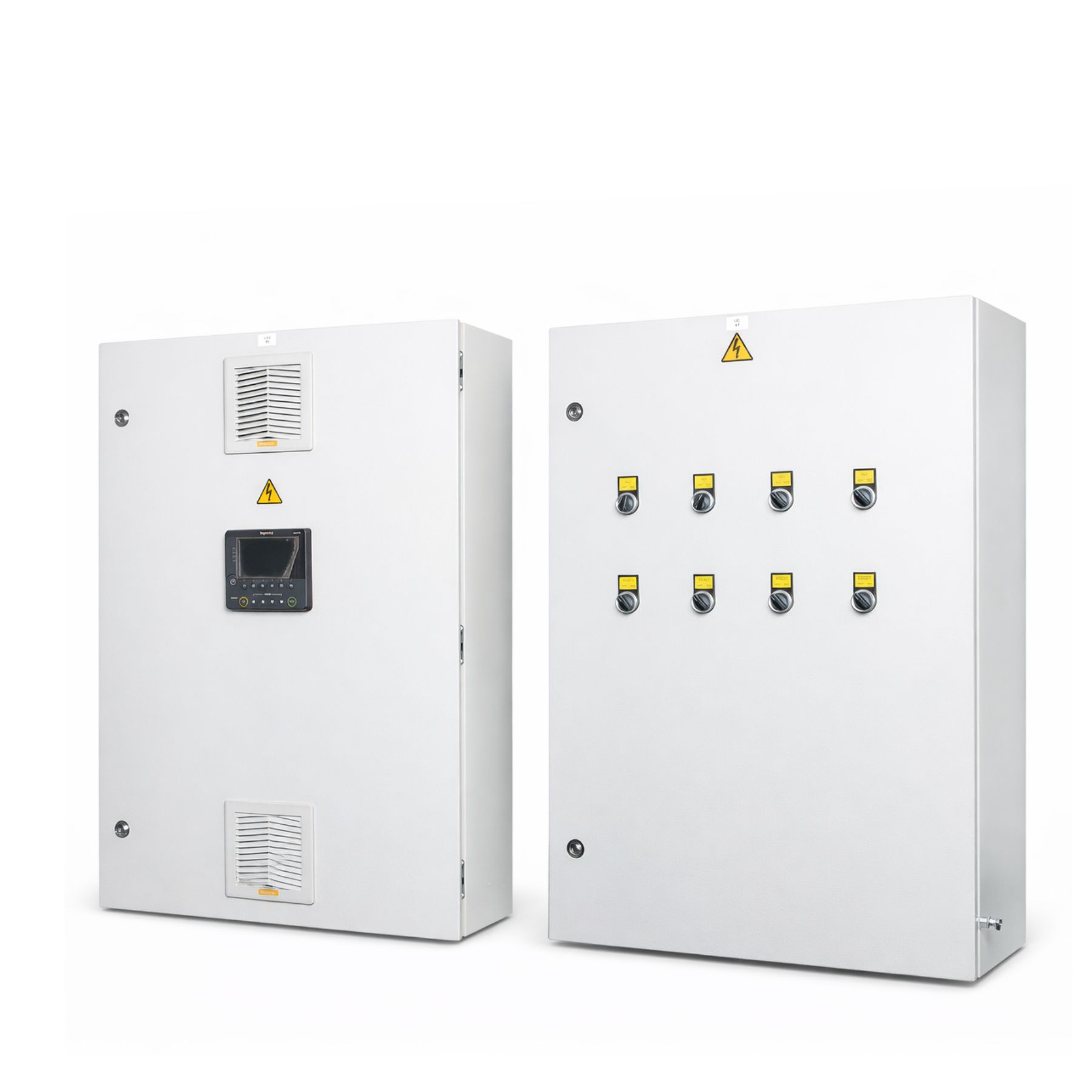
Electrical cabinets
GENERAL INDUSTRIAL POWER CABINETS
General industrial power cabinets are designed for the input, metering, and distribution of electrical energy, as well as for the protection of electrical consumers in networks with voltages up to 380V AC outside explosive hazardous areas. The general industrial power cabinet is a structure consisting of a metal or plastic enclosure with a removable panel, secured with a latch or a lock. Mounting brackets for wall installation, fastening for the cover, and grounding studs are attached to the cabinet body. A sealing gasket is installed on the cover to protect the interior from environmental influences. Connection to the power circuit is made by connecting the input cables to the input terminals of the circuit breaker.
A mounting panel is installed inside the cabinet, onto which components are mounted. The cabinet configuration may vary depending on its application.
EXPLOSION-PROOF POWER CABINETS
Explosion-proof power cabinets are designed for the input, metering, and distribution of electrical energy, as well as for the protection of electrical consumers in networks with voltages up to 380V AC within explosive hazardous areas. Functionality and Design: The explosion-proof power cabinet is a structure consisting of a metal enclosure with a removable panel, secured with a latch or a lock. Mounting brackets for wall installation, fasteners for the cover, and grounding studs are attached to the cabinet body. A sealing gasket is installed on the cover to protect the interior of the product from external environmental influences. Connection to the power circuit is made by connecting the input cables to the input terminals of the circuit breaker.
The construction includes a mounting panel, onto which components are installed. The configuration of the cabinet may vary depending on its intended use.
GENERAL INDUSTRIAL CONTROL CABINETS
The primary function of general industrial control cabinets is continuous monitoring of system control parameters and providing corrective control actions outside explosive hazardous areas. Control cabinets may either use relay-based control circuits or programmable logic controllers (PLCs). Relay-based control circuits have a fixed operational logic. If changes to the logic are required, the entire algorithm may need substantial rework of the cabinet’s schematic. Relay cabinets are typically used for equipment management where no changes to parameters or setpoints are needed during operation.
More advanced devices, such as systems based on programmable logic controllers, have allowed a qualitative and quantitative breakthrough in the speed and flexibility of control system implementation and modernization. For process visualization, an operator panel is used. The control on the operator panel is implemented using a touch interface. The operator panel is located on the door of the cabinet.
ALARM CABINETS OF GENERAL INDUSTRIAL DESIGN
The cabinets are manufactured in accordance with the requirements of the fire and security alarm project. The cabinets are equipped with autonomous backup power sources, as the equipment for fire protection systems is classified as the first category for power supply reliability. The cabinets can be made for both address and non-address systems. A fire alarm cabinet made for an addressable system allows for precise identification of the fire location by recording the address and transmitting it to the signal reception point.
EXPLOSION-PROOF ALARM CABINETS
The cabinets are manufactured in accordance with the requirements of the fire and security alarm project. The cabinets are equipped with autonomous backup power sources, as the fire protection equipment is classified in the first category for power supply reliability. The cabinets can be made for both addressable and non-addressable systems. A fire alarm cabinet built for an addressable system allows for precise identification of the fire location by recording the address and transmitting it to the signal reception point.